Early institutional experience using the real-time deflectable tip technology of SmartGUIDE™ (CNS 2025 Abstract)

October 11, 2025

Real-Time Deflectable Tip Guidewire For Complex Intracranial Navigation—An Early Institutional Experience

Albert Q. Wu1*, Priya Gaiha2, Kyle Scott1, Redi Rahmani1, Sandeep Kandregula1, Joshua S. Catapano1, Omar Choudhri1, Visish M. Srinivasan1, Jan-Karl Burkhardt1

1Department of Neurosurgery, Perelman School of Medicine, University of Pennsylvania, Philadelphia, PA 19104

2Corporate Research, Artiria Medical SA, Canton de Vaud, CH

*Presenting author
INTRODUCTION

Guidewires are used to select vessels and navigate tortuosity in endovascular procedures. The angle of most J-tip guidewires, such as Aristotle and Synchro, must be chosen or modified ex vivo. We report an early single-institution experience with the SmartGUIDE guidewire (Artiria Medical, Geneva, Switzerland), which allows real-time in situ distal tip deflection and locking.

STUDY OBJECTIVES

To present preliminary safety, efficacy, and usability data of a deflectable tip guidewire in neurointerventional procedures.

METHODS

  • This was a single-arm, open label prospective study using an FDA cleared device for 23 procedures between August 2024 to May 2025.
  • Data included target vessel access, first-line vs. rescue use, and device-related safety events.
  • Usability was rated via a 5-point Likert scale on six domains: torque, pushability, navigation, shape retention, trackability, and radiopacity.
  • Patients underwent standard postoperative imaging follow-up.

RESULTS

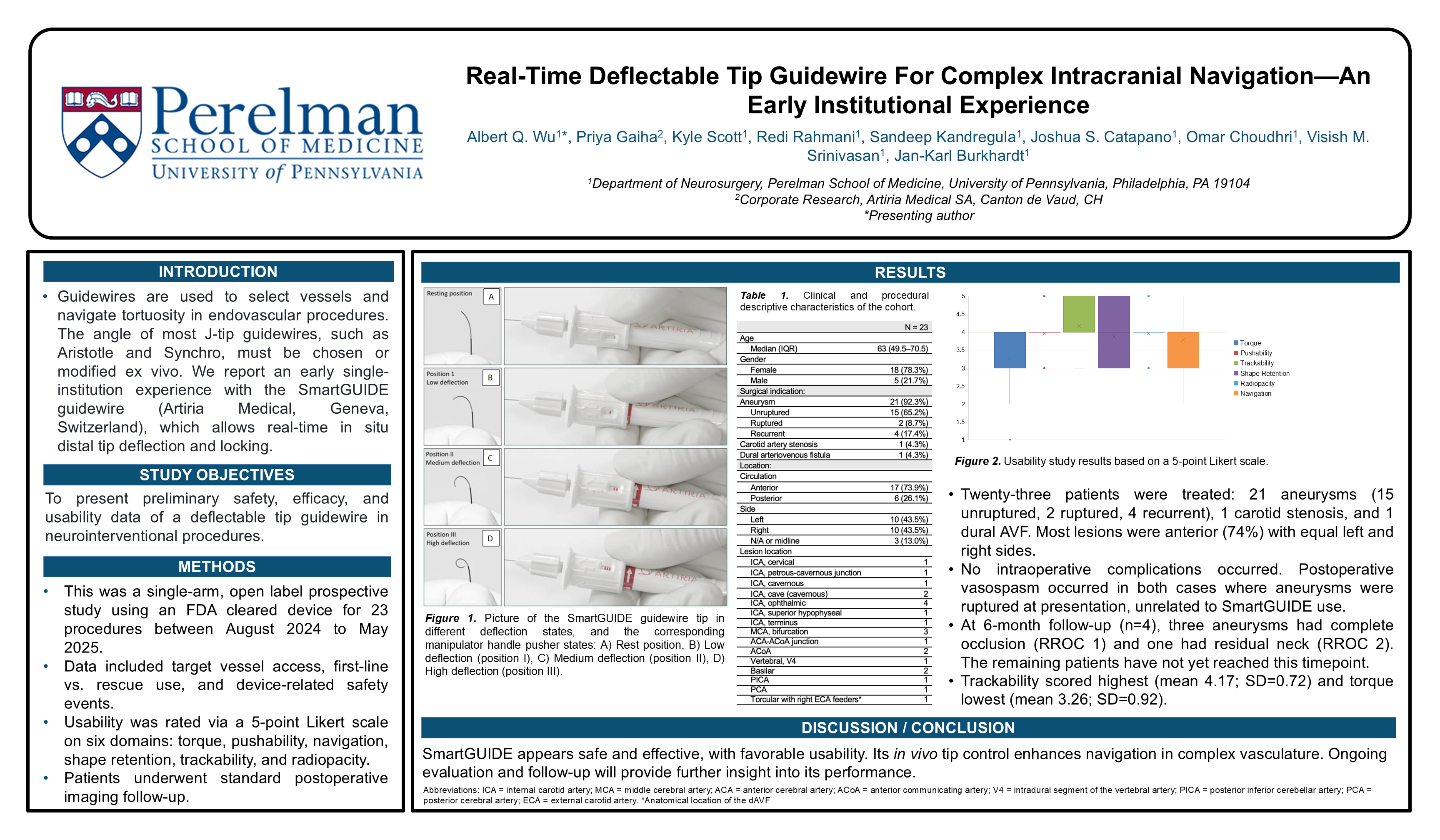
  • Twenty-three patients were treated: 21 aneurysms (15 unruptured, 2 ruptured, 4 recurrent), 1 carotid stenosis, and 1 dural AVF. Most lesions were anterior (74%) with equal left and right sides.
  • No intraoperative complications occurred. Postoperative vasospasm occurred in both cases where aneurysms were ruptured at presentation, unrelated to SmartGUIDE use.
  • At 6-month follow-up (n=4), three aneurysms had complete occlusion (RROC 1) and one had residual neck (RROC 2). The remaining patients have not yet reached this timepoint.
  • Trackability scored highest (mean 4.17; SD=0.72) and torque lowest (mean 3.26; SD=0.92).

Figure 1. Picture of the SmartGUIDE guidewire tip in different deflection states, and the corresponding manipulator handle pusher states: A) Rest position, B) Low deflection (position I), C) Medium deflection (position II), D) High deflection (position III).

Table 1. Clinical and procedural descriptive characteristics of the cohort.

Figure 2. Usability study results based on a 5-point Likert scale.

DISCUSSION / CONCLUSION

SmartGUIDE appears safe and effective, with favorable usability. Its in vivo tip control enhances navigation in complex vasculature. Ongoing evaluation and follow-up will provide further insight into its performance.

Abbreviations: ICA = internal carotid artery; MCA = middle cerebral artery; ACA = anteriorcerebral artery; ACoA = anterior communicating artery;V4 = intradural segment of the vertebral artery; PICA = posterior inferiorcerebellar artery; PCA = posterior cerebral artery; ECA = external carotidartery. *Anatomical location of the dAVF

About SmartGUIDE™ 014

SmartGUIDE™ 014 is a real-time deflectable guidewire that enables in situ tip control for navigation in complex neurovascular anatomy without wire removal or hand-shaping. SmartGUIDE™ 014 is FDA cleared and CE marked and commercially available in the United States and Europe.

About Artiria Medical

Artiria Medical is a Swiss medical technology company developing innovative solutions for neurovascular procedures. Artiria’s mission is to deliver innovative solutions to treat hemorrhagic and ischemic strokes — leading cause of disability and death worldwide. More information is available at www.artiria-medical.com.

Contact information

Artiria Medical SA, Switzerland

communications@artiria-medical.com